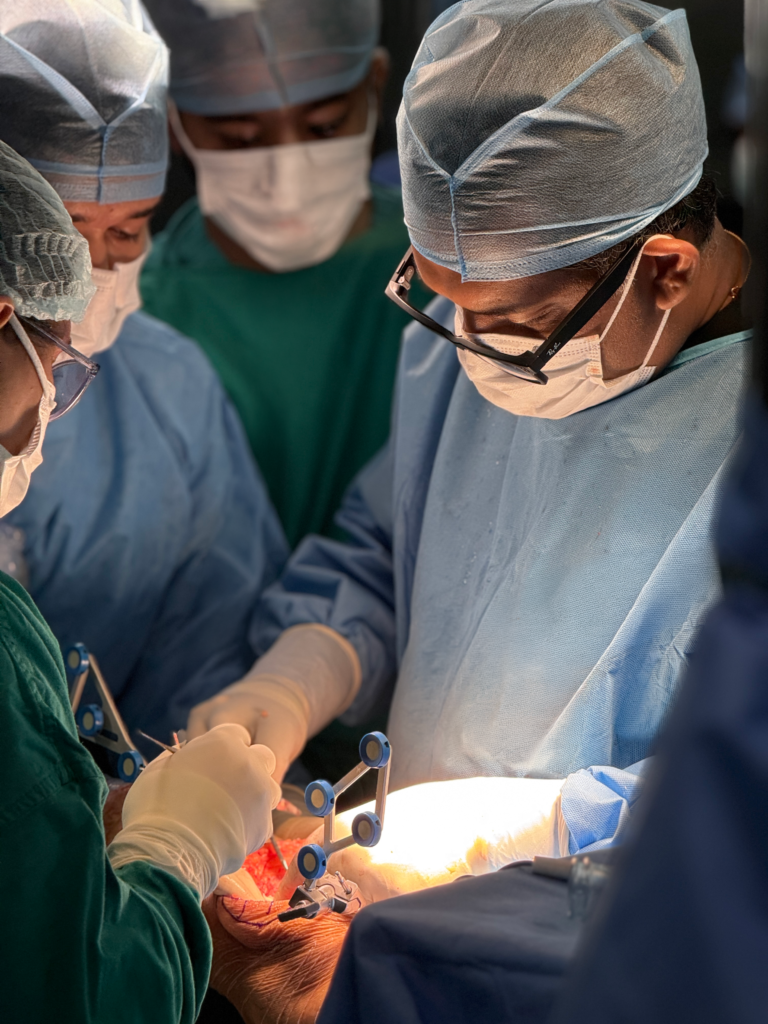
When a knee joint is worn beyond repair — usually from arthritis — total knee replacement restores movement and relieves pain by replacing the damaged surfaces with metal and plastic components. The surgery itself has been refined over decades, but one challenge always remained: every patient’s knee is shaped a little differently, and traditional surgical instruments could only approximate the right fit.
Robotic-assisted knee replacement changes that. Using a handheld robotic device and real-time bone mapping, your surgeon can plan and execute the surgery with a degree of accuracy that was simply not possible before. The result is an implant that fits precisely the way your knee works — not the way an average knee works
THE TECHNIQUE
How the CORI** system works
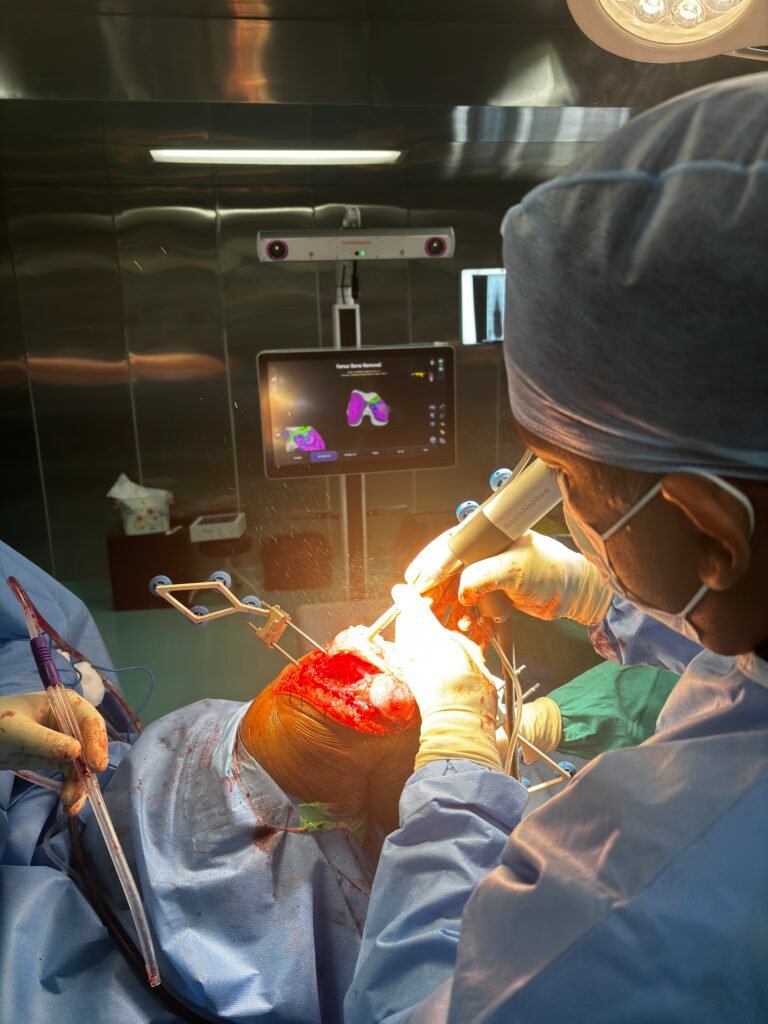
The CORI Surgical System by Smith & Nephew is a handheld robotic platform — there is no large robotic arm standing over the operating table. Instead, your surgeon uses an instrument that looks and feels like a conventional tool, but is guided at every moment by a computer that knows the precise shape of your own bones.
Before any cutting begins, the system builds a three-dimensional map of your knee during surgery itself, without requiring a pre-operative CT scan. Your surgeon then plans where each implant surface should sit, and the robotic handpiece actively resists any movement outside those boundaries — a feature called Dynamic Bone Registration. This means the cuts made to your bone are accurate to within fractions of a millimetre
PERSONALISED FIT
The implant position is planned around your own anatomy, not a standard template.
FASTER RECOVERY
Less bone and soft-tissue disturbance typically means a smoother, quicker recovery.
BETTER ALIGNMENT
Precise alignment reduces wear on the implant and helps the knee move naturally.
IMPLANT LONGEVITY
A well-aligned implant is under less stress, which may extend how long it lasts.
SOFTER TISSUE HANDLING
Controlled cuts mean less trauma to the surrounding muscles and ligaments.
INTRAOPERATIVE DATA
Your surgeon sees live feedback throughout the procedure — not just before or after.
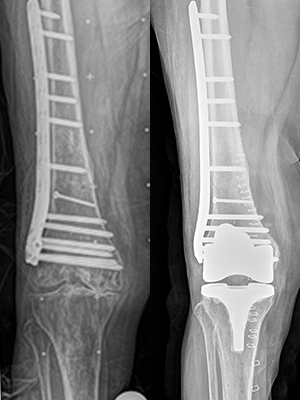
A particular advantage worth noting is the ability to perform total knee replacement in patients who have a prior implant in the femur — such as a plate and screws from a previously united distal femur fracture. In conventional knee replacement, passing an intramedullary rod up the femoral canal is a standard step used to set the cutting guide alignment. When a plate or nail already occupies that space, this becomes technically impossible or hazardous, and many such patients are told that knee replacement cannot be offered to them.
The CORI system bypasses this entirely. Because it maps the bone surface in real time and derives all alignment data from that map, it requires no intramedullary rod whatsoever. The existing metalwork poses no obstacle. Surgery can proceed safely and with the same precision as in any other case. Patients who were previously told they could not have a knee replacement due to prior fracture fixation can now be offered a reliable and lasting solution
The X-rays on the Right side shows, a patient with united fracture distal femur and severe osteoarthritis of knee. Conventional TKR needs removal of the plates whereas I could do it without removing the plate, with robotic arm assisted TKR
Is robotic knee replacement right for you?
Robotic-assisted surgery is suitable for most patients requiring total knee replacement, including those with significant deformity of the knee. Your surgeon will discuss your X-rays, your overall health, and your expectations to advise whether robotic surgery is the best option for you. If you have specific concerns — about the procedure, recovery, or the technology itself — please raise them during your consultation. There are no questions too small when it comes to a decision of this importance.
**CORI Surgical System is a registered product of Smith & Nephew.